
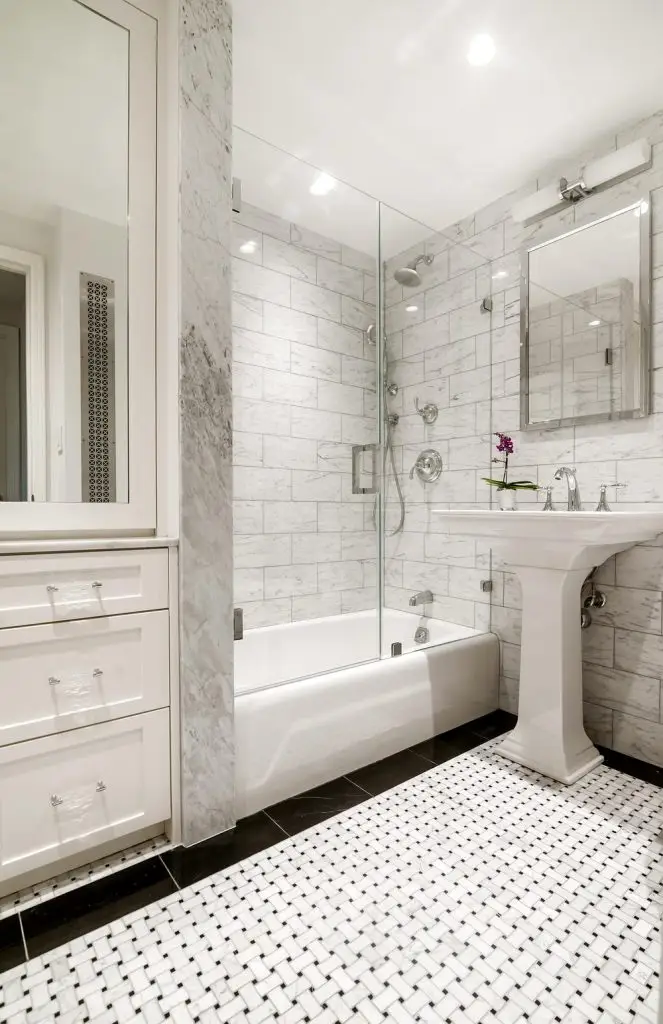
In New York, small bathrooms are shaped by fixed plumbing locations, narrow clearances, and the constraints of existing structure. These limitations leave little room for alteration, so design must work within what already exists. In such compact spaces, proportion and material become the means of creating visual and spatial resolution. Every element carries weight; each decision affects how the room functions and how it feels. The goal is not to make the room appear larger, but to make deliberate choices that allow it to feel complete within its boundaries.
Because these spaces rely on what cannot move, detail becomes structure. Joints, alignments, and transitions take on architectural importance, defining the sense of order within the room. Clarity comes not from scale but from how surfaces meet and elements relate. The veining in stone, the slight variation in a handmade tile, or the way light moves across painted plaster shape how the space is experienced. Each element must earn its place, contributing to a coherence that makes the bathroom feel both balanced and composed.
That discipline continues through proportion and alignment, which are shaped by the dimensions of fixtures and finishes. The projection of a faucet, the depth of a vanity, and even the swing of a door can alter how generous or confined the room feels. Each element finds its balance not in isolation but through its relationship to the next. When these relationships are carefully considered, the room feels calm and cohesive.
Such precision is established before construction begins. Small bathroom design succeeds only when the intentions of proportion, relationship, and material coherence are fully resolved through drawing and detailing. In practice, every junction, alignment, and transition is determined in detail so that, once built, nothing feels arbitrary. Tile joints, fixture alignments, and material transitions are planned to the millimetre.
Small bathrooms succeed not through decoration but through intention and precision in their details. The result is not a larger space but a more coherent one — a small bathroom that feels composed, contained, and quietly assured.
Wondering how to make a small bathroom feel less compromised and more composed?